
First-Ever Beaver Coexistence Project with Landowner & VTrans Launches in Orange, Vermont
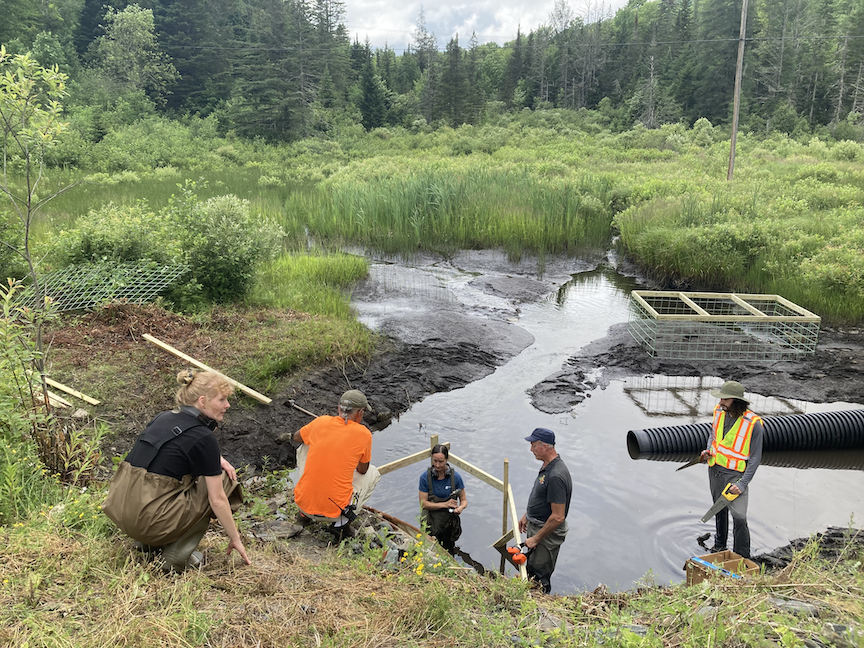
Orange, VT – July 10, 2025 – A groundbreaking ecological installation will take place at Culvert #17, along Route 302 in Orange, Vermont on Thursday July 10th. In a historic first, the Vermont Agency of Transportation (VTrans) will partner with local landowners and conservation organizations on a coexistence strategy to mitigate ongoing conflicts with beavers by installing a flow device – commonly known as a Beaver Deceiver – which is designed to manage water levels at a roadside wetland while protecting transportation infrastructure.
Spearheaded by Sage Mountain Botanical Sanctuary, with funding from In Defense of Animals and project support from Vermont Wildlife Patrol, Vermont Wildlife Coalition, and the Vermont River Conservancy, this installation marks the first formal public-private partnership between VTrans and private landowners aimed at nonlethal beaver coexistence. The device will be installed by Skip Lisle of Grafton, Vermont, who – with the Penobscot Nation of Maine – patented the Beaver Deceiver technology.
“We are witnessing the return of beavers after having been wiped out in the mid-19th century. Our infrastructure was not designed to accommodate the passage of wildlife or the flood resilience benefits that beavers bring,” said Rod Coronado, Director of Wildlife Programs at Sage Mountain Botanical Sanctuary. “Across Vermont, road crews spend hundreds of thousands of dollars removing dams and unblocking culverts each year. This is an opportunity to both save money and restore an important wetland.”
“This project offers a model for proactive, ecologically sound solutions that protect both public safety and biodiversity,” said Emily Ruff, Executive Director of Sage Mountain Botanical Sanctuary. “In the face of intensifying storms and flooding across Vermont, working with beavers to restore and maintain wetlands is one of the most effective and low-cost climate resilience strategies available.”
Beavers are natural engineers whose dams slow water, reduce erosion, recharge groundwater, and expand critical habitat for countless species. Yet in many areas, their presence near roads can lead to conflict. Flow devices like this one allow water to pass through beaver dams in a controlled way, preventing road flooding and culvert damage without resorting to trapping or habitat destruction.
Fall tours of the site will be organized to engage the public, landowners, and policymakers in hands-on education about wetland restoration, road resilience, and peaceful coexistence with keystone species.
To learn more about this project and upcoming tours, contact Sage Mountain Botanical Sanctuary at info@sagemountain.com or 802-479-9825.

You May Also Like